Saturday, April 21, 2007

BKASC: Oslo

Today's Better Know a Scandinavian City, the most expensive city in the world: Oslo.

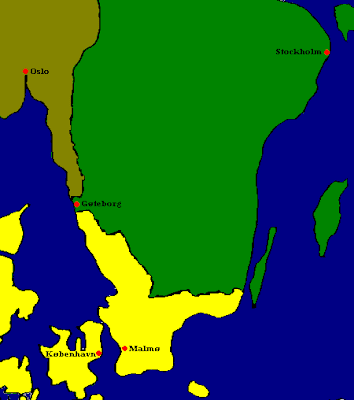
Oslo is the capitol of modern Norway, and home to about 800,000 Oslites. It was once a city of vast importance to the Danish/Norwegian alliance against the Swedish empire in the 16th century (yes, it took two empires to stand up against Sweden). As it seems for every old city, in 1624 a fire devastated old Oslo, and the city was rebuilt some kilometers west.


Expansion of the Swedish Empire

As we later found out, Norway isn't about the city life, it is about the nature that surrounds the cities. Whilst Oslo is beautiful in its own respect, the true beauty of Oslo comes into perspective when one ventures outside of the walls.


Oslo Port

Oslo was home to the 1952 Winter Olympics, which found their home among the many mountains and slopes of the glacier carved land. No wonder Norway has won more medals than any country for cross-country skiing!


Got Skis?

Oslo was the home of famed painter, Edvard Munch. His childhood was spent surrounded by the death of family members, which may attribute to the style of his paintings.
"Sickness, insanity and death were the angels that surrounded my cradle and they have followed me throughout my life." -Munch
The Edvard Munch Museum is home to over 1,100 Munch works (The Scream however is not on display as we found out, because it had been recently stolen and damaged)


Munch's Scream, recreated on a building

As we soon found out, the best of Norway was yet to come... stay tuned for a special feature, "Better Know a Scandinavian Mountain Range."

Friday, April 20, 2007

BKASC: Sarpsborg

Today's Better Know a Scandinavian City, and home of the original Bakkelund: Sarpsborg

Sarpsborg was founded by the Viking King Olav Haraldsson in 1016. Unfortunately most of the old city ended up in the river Glomma, after a mudslide between 1200-1400. The city was rebuilt at a safer location but was burnt down to the ground by the Swedish invaders in 1567 (are you getting the common theme here?)


Welcome to Sarpsborg

Sarpsborg is officially the brightest city in Norway, when it was declared the sunniest place in the entire country for the year 2005. I'm going to have to agree with them, as the one day we were there, the sun shone down on us.

The city was home to the family Bakkelund, before they immigrated around 1900 to America. The literal meaning of the name Bakkelund is, "hill-grove." A fairly accurate description of the Bakkelund that I know.


Jon, the first Bakkelund to return to the homeland.

The city is a blue collar economy, with many of its 50,000 inhabitants working industrial jobs. It is also home to Borg beer brewery, the most famous of the Norwegian Pilsners.


Bakkelund drinking a Borg in Sarpsborg, now there is a Norwegian scene

It is fairly clear why the Bakkelunds left Sarpsborg, as the city isn't much to look at. What is ironic however, is that the Norwegian countryside looks EXACTLY the same as the Wisconsin countryside. I guess people stick to what is familiar to them. Take a walk in Sarpsborg by clicking here.


Vestvannet Lake (Fjord?)

Thursday, April 19, 2007

BKASC: Gothenburg

Today's Better Know a Scandinavian City: Gothenburg


The city of Gothenburg was named after the Geats, famous from their portrayal in Beowulf. It is centrally located between the Norwegan stronghold in Oslo, and the Danish stronghold in Kobenhavn.


Goteborg

Because of its geographical location, the modern city is home to the most important port in Scandinavia. The city is also home to Gothenburg University and the Chalmers University of Technology, which together make Gothenburg the largest university city in Scandinavia.


A replica of the sailing ship Götheborg departed for China in a recreation of the historical 18th century trade route to the Chinese city of Guangzhou.

Economically, the city is home to the headquarters of Volvo (latin for "I roll"). Volvo, or "woll woll" in Swedish, is the worlds leading producer of heavy trucks, and is famous for their safety innovations such as the modern three-point seatbelt.


The Familiar Volvo Grill

The cuisine of the area is obviously rich in fish, and has become famous worldwide for the Feskekôrka ("Fish Church"), an indoor fish market. The city also has a number of star chefs – over the past decade, 7 of the Swedish Chef of the Year Awards have been won by Gothenburgers.


The Swedish Chef


The Swedish Eater


A walk along the port is common for Gothenburgers. The dialect of the Gothenburgers is, according to other Swedes, associated with cheerfulness and witty humor. No wonder I felt so at home there!


Gothenburg Harbor

Wednesday, April 18, 2007

BKASC: Malmö

Today's Better Know a Scandinavian City: Malmö

Malmö was originally settled as a Danish city in 1275, and was for many centuries Denmark's second largest city (after Kobenhavn). It remained a Danish city until the 17th century, when Sweden royally raped and pillaged what was left of Denmark, and took 1/2 of Denmark's territory. Because of this intense war history, Malmö served as a key military port throughout the Scandinavian wars.


King Karl X Gustav of Sweden, who took the city from Danish dominion

Wars aside, Malmö is now Sweden's third most populous city, and is located on the southernmost region of Sweden. Its close ties with Denmark have remained, and in 1999, a bridge was built connecting Copenhagen to Malmö. Many residents of Malmö choose to live in Malmö and commute 20 minutes by train to work in Copenhagen (given the opportunity, who wouldn't want to live in Sweden?)


The bridge-tunnel Oresund, the longest combined road and rail bridge in Europe.

Upon first arrival, it is not easy to distinguish Sweden from Denmark, but the subtle differences are what make Sweden the best country on Earth (citation needed).
Jon, seconds after entering Sweden: "I wonder how long it will be until we see our first IKEA?"
Ben: "There's one!" (pointing to an IKEA)
After soaking up a lifetime of Swedish identity, I walked into a local church, and high school choir of Swedish girls were singing a hymn of Heaven on earth (I can only assume). Not a bad way to spend my first moments in the homeland.


Blonde haired women grow on trees and Swedish meatballs rain from the sky in this land of milk and sweet lingonberry honey.

Malmö is home to Scandinavia's tallest building, the Turning Torso. Don't be too surprised if I come home with a 6,000 kroner mortgage for a flat in this beauty.


The design gives the building the appearance of a vine twisting its way up a pole toward the sun.

Great Scandinavian city, or greatest Scandinavian city? ...it's too early for me to judge.


One need not sightsee or worry about visiting all the important landmarks while in Malmö, just sit back and take in the beauty.

Tuesday, April 17, 2007

BKASC: Kobenhavn (Copenhagen)

Today's Better Know a Scandinavian City: Kobenhavn

Kobenhaven is Denmark's largest city, with 1.8 million Danes living in the greater Kobenhavn area. The name Kovenhavn, literally translates to merchants harbor, and it couldn't be more true.


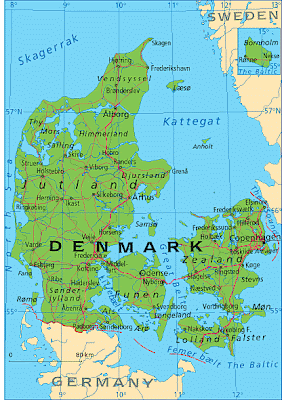
Denmark

The city is situated on the Island of Sjælland, which is connected to the rest of Denmark by the Great Belt Fixed Link, which is the worlds second longest suspension bridge. The two towers that make up the bridge are actually the highest points in all of Denmark.

Despite being an expensive city to live in, it has been rated the number 10 city in the world to live in. It is home to Strøget, the longest pedestrian shopping street in the world, which does not disappoint (if you like shopping.) I also made my European debut at a karaoke bar on this street, which will quickly become known as "The street Ben made his big break."


Strøget at Night

Perhaps the biggest draw of the city, however, is the port and its surrounding waters. The city was founded by Vikings around 1167, so a location along the water and trade routes was vital.


Viking Ship Museum

The area of the city known as Nyhavn is home to the famous colored buildings along the harbor, which today offer a variety of places to eat. The north side of the port used to be called the naughty side, with sailors visiting small flats during their shore leave. The south, or nice side of the port was home to the markets which sailors sold their goods at.


Nyhavn

A controversial portion of the city, known as Christiania, cannot be described, but is rather experienced. The neighborhood covers 85 acres in Copenhagen and is home to 850 pseudo-residents in the "lawless" city (recently regulations on hard drugs have been enforced by Copenhagen Politi). This "Freetown" has established semi-legal status as an independent community, and has been passed as a social experiment by the Danish Government.


A walk down pusher street

Who could forget that Hans Christian Anderson comes from Denmark? Many of his stories were inspired by the sights and sounds in Denmark.
"Far out at sea the water´s as blue as the petals of the loveliest cornflower, and as clear as the purest glass; but it´s very deep, deeper than any anchor can reach. Many church steeples would have to be piled up one above the other to reach from the bottom of the sea to the surface. Right down there live the sea people."

Den Lille Havfrue (The Little Mermaid)

Also born and buried in Copenhagen was famous Philosopher, the Father of Existentialism, Søren Kierkegaard.
"Life can only be understood backwards; but it must be lived forwards."

Kierkegaard's Grave

It is easy to see why the arts have flourished in this city, and it has quickly become the cultural center of Scandinavia. A stroll down Nyhavn Vej clearly gave and continues to give inspiration to all that walk in its path.

Monday, April 16, 2007

BKASC: Billund

Scandinavian Cities... they all have their charms. In today's installment of the 436 part series, "Better Know a Scandinavian City," Billund.

Billund is home of The Lego Group, where 90% of the world's Legos are produced. Billund is also home to Legoland, consisting of Duplo Land, ImaginationZone, LEGOREDO Town, Adventure Land, Miniland, Pirate Land, Lego City, Knights Kingdom and Viking land.


The park opened in 1968 and sees 1.6 million visitors annually. The original part of the park is home to acres and acres of Lego creations, from a scale model of the Statue of Liberty to a life-sized elephant.


Take a stroll down Lego Lane and you'll see replicas of cities such as Copenhagen, Amsterdam, London, New York, and Tokyo.


Don't forget the "It's a Small World" lazy boat tour through the Lego world.


The modernized portion of the park has rides such as the Lego Teacups and the LegoBuilder. The LegoBuilder is essentially a GM car building robot arm with a harness attached to the end.


No trip to Legoland would be complete without a snapshot with one of the seemingly hundreds of Lego Princesses present in the park (the more Lego bricks used to make the Lego Crown, the more beautiful the princess)


I handed in my application as a Lego architect, and am anxiously waiting to hear back. I think being a Lego Prince in Legoland has moved up to number 1 on my list of things to do when I grow up (which obviously isn't going to happen for a while!)

All of Legoland can be enjoyed here.

Intorducing: Better know a Scandinavian City...


I have returned from the grand tour of Scandinavia... Stay tuned for a new original series: Better know a Scandinavian City.

Saturday, April 7, 2007

Check-in from Oslo...


Easter is upon us! Happy Easter to all readers, and look forward to some wonderful Easter pics from Norway, Sweden, ect... Here are some appitizers from Germany, Denmark, and Sweden...

Click on the thumbnails on the right to view the cities...

Friday, March 30, 2007

I'm going "home..."


This is Murtorpet. My Great-Great Grandfather, Carl August Johansson was born and raised on this farm. At the Age of 24, he packed up his things and Emigrated with his family to America in 1890.

Tomorrow I begin my pilgrimage back to my homeland. This is probably the most exciting trip of my life... I hope I will be able to see the farm, and meet some of my relatives that did not emigrate to America.

Updates over the next two weeks may be sparatic, but look forward to some awesome pictures and a general GREAT time!

Thursday, March 29, 2007

US 'no longer technology king'

BBC NEWS | Business | US 'no longer technology king': "US 'no longer technology king'

The US has lost its position as the world's primary engine of technology innovation, according to a report by the World Economic Forum."
The US is now ranked seventh in the body's league table measuring the impact of technology on the development of nations.

A deterioration of the political and regulatory environment in the US prompted the fall, the report said.

The top spot went for the first time to Denmark, followed by Sweden.

Countries were judged on the integration of technology in business, the infrastructure available, government policy favourable for fostering a culture of innovation and progress and leadership in promoting the usage of the latest information technology tools.

The Networked Readiness Index, the sixth of its kind published by the World Economic Forum with Insead, the Paris-based business school, scrutinised progress in 122 economies worldwide.

Despite losing its top position, the US still maintained a strong focus on innovation, driven by one of the world's best tertiary education systems and its high degree of co-operation with industry, the report said.

NETWORKED READINESS INDEX RANKINGS 2006 (2005)
1: Denmark (3)
2: Sweden (8)
3: Singapore (2)
4: Finland (5)
5: Switzerland (9)
6: Netherlands (12)
7: US (1)
8: Iceland (4)
9: UK (10)
10: Norway (13)
Source: WEF

The country's efficient market environment, conducive to the availability of venture capital, and the sophistication of financial markets, was also given recognition.

Denmark is now regarded as the world leader in technological advancement, with its Nordic neighbours Sweden, Finland and Norway claiming second, fourth and 10th place respectively.

"Denmark, in particular, has benefited from the very effective government e-leadership, reflected in early liberalization of the telecommunications sector, a first-rate regulatory environment and large availability of e-government services," said Irene Mia, senior economist at World Economic Forum.

European countries to make the top 20 included Switzerland in fifth place, the Netherlands, one of the most improved in sixth, the UK (nine), Germany (16), Austria (17) and Estonia (20).

While countries from Asia and the Pacific continued to progress, the powerhouse economies of China and India both showed a downward trend.

India was four positions down on last year to 44th, suffering from weak infrastructure and a very low level of individual usage of personal computers and the internet.

China was knocked to 59th place, nine positions down, with information technology uptake in Chinese firms lagging.

Wednesday, March 28, 2007

You win second prize in a beauty contest... collect $10.

I have lived here in Denmark for about two months now, and I have come to appreciate many things. Sure they don't have million dollar houses and Hummers. They don't have attics and sheds full of unused possessions. They don't even have Kellogg's Captain Crunch! What they do have though, is a population of people that are kind, helpful, and most of all, humble. They live one of the highest standards of living in the world, without relying on their possessions. They appreciate what they have, and care a great deal about what they have been given.


My favorite saying of the Danish people is,

"Denmark: Where few have too much, and even fewer too little."


I think we have a lot to learn from this place I now call home.

Tuesday, March 27, 2007

Innovative Danes

Warning... slightly NSFW (Not Safe for Work)... European style nudity.
http://www.youtube.com/watch?v=NPoOK7_2tts

Early Morning Theory


In my lawnmower induced awakening too early this morning, I came across this article that clearly describes me (I just signed up for my MU classes, and I don't have any before 12:00 every day):


Being on the B-list will no longer be a sign of being second rate at one Copenhagen secondary school - just a late riser


Starting this autumn semester, students at HF Centret Efterslogten in Copenhagen's North-west district can forget about setting their alarms.

HF Centret, a secondary school preparing people for certain professions falling outside those offered at universities, will offer a test group of type-B students classes starting at 12:30 pm. The school plans to extend the programme to an entire year starting in 2008, offering a complete 10-5 format.

The initiative was started by the B-society, an association that supports type-B people and helps promote their lifestyle. According to society president Camilla Kring the group's school's initiative is the start of a 'revolution'.

'It's fantastic and we expect the trend to catch on elsewhere. We want to have B-grade schools, B-high schools and B-nursery schools. This is only the first step on the path.'

The B-movement has exploded since Jyllands-Posten newspaper published an article about the Copenhagen-based association in January, when B-Society had a mere 67 members. It now has 3880 members, including many from Sweden and Norway.

Studies show that up to 25 percent of the population are B-types, who normally prefer staying up later in the evenings and sleeping late in the mornings.

Ole Vadmand, a student counsellor at the school, said the idea of later classes benefits everyone, not just the students.

'None of our students or teachers have to go out and milk the cows anymore, so there's no reason to continue to living in a society modelled after agrarian routines.'

Vadmand said that when he first mentioned the idea of later classes to his students, the clear response was that nearly all of them wanted them - not just the B-types.

Kring said she is looking into starting another association for A-types, which make up some 15 percent of the population.

Is the grass greener on the other side?

I've been hearing how warm it is back home, but how long and green is your grass? Every Tuesday morning since I have been here, Søren has fired up the græs gennemskæring (lawnmower) at 8:00AM to cut the long, thick, green grass here. Winter never really happened here, and the grass never stopped growing. So I ask you, readers... is the grass really greener on the other side?

Monday, March 26, 2007

American English


I came across this little worksheet stuck in a bush in front of the elementary school right outside my flat. I guess this explains why all the Danes speak English so well... they learn it starting right in elementary school from this handy little "American English" work book. With only 5.5 million Danes, they are forced to be bilingual, which would be an understatement considering most of them also speak Swedish and/or German (which are not as similar as I was lent to believe.) In high school, they choose another language to take another four years of (mainly French or Spanish.) Danish, German, English, Spanish, French, Swedish, German... I don't know how they keep them all straight, but then again, I am a student of the American education system.