Showing posts with label BKASC. Show all posts

Saturday, April 28, 2007

BKASC: Bo Socken

Today's Better Know a Scandinavian City: Bo Socken
"Johan August Persson and Johanna Sofia Olsdotter were married about 1854. Johan was born on April 3, 1833 at a farm called Murtorpet located in Bo socken, a parish in the province of Närke.


Murtorpet

Following their marriage, Johan and Johanna lived at this same farm. The occupation of Johan was listed in the church records as crofter, a man who rented his cottage and paid for it by working for the owner of the land a fixed number of days. Johan and Johanna had seven children, but two died at very young ages. Their eldest son, Carl August, was six years old and his brother, Gustaf Adolf, was three when their sister Emeli was born in 1861. Two years later, Emeli died just four months after her sister Anna was born. Anna also died before reaching her second birthday. A son, Johan Axel, was born following the death of Anna. Their only surviving daughter, Frida Kristina, was born in 1868. In 1871, their youngest son, Malcolm Hugo, was born.


Modern Murtorpt

During the last half of the nineteenth century, many different factors were causing people in Sweden to emigrate to the United States. Among these were religious persecution, deteriorating economic conditions, drought and dwindling land availability. In 1880, Carl August, the oldest son, decided to emigrate to the United States. Although emigration was occurring all around them, Johan and Johanna must have had considerable heartache with the departure of a son to a foreign country, knowing that he probably would never return to Sweden and the farm called Murtorpet." (murtorpet.se)
Carl August was my Great-great grandfather. He was the first among his family to emigrate to America. In the spirit of my great-great grandfather's tenacity, I made my voyage back "home."


Me, back on the farm

Wednesday, April 25, 2007

BKASC: Örebro

Today's Better Know a Scandinavian City: Örebro

Örebro is a smallish town in the center of Sweden, one hour west of Stockholm. The countryside around Örebro is similar to what one would expect to find in the Great Plains of the USA.


Wisconsin or Örebro?

Örebro literally means a bridge over gravel banks, which is how the geography looks, with the stream Svartån draining into the lake Hjälmaren.


The landscape is flat, farmed, and barned.

The city is the birthplace of Mary Stavin, Miss World 1977. She also starred in James Bond: Octopussy and A View to a Kill, as agent Kimberley Jones.


Swedish beauty, timeless.

Örebro also has a suburb, which a certain Swede in America's Swedish relatives come from... stay tuned for the climax of my Journey home...

Tuesday, April 24, 2007

BKASMR: Scandinavia's Fjällen

Today is a special edition of Better Know a Scandinavian City: The Fjällen (The Fells) Mountain Range.


Fjord in the fog

Known for forming the Fjords of Norway, this Mountain Range cuts through Norway, Sweden, and Finland. Whilst not the highest mountains, these peaks have the added beauty of being cut through by the many fjords and rivers of Norway.


City, on the rocks

Unknown to a foreigner, the E16 road from Bergen to Oslo isn't your typical road. First of all, look out for trucks, because they know exactly what they are doing, and do it at the highest speeds possible. A semi blew by me on several locations as we winded our way down passes that didn't look navigable a mountain goat.


Got Chains?

Second of all... don't expect the road to even be open in the middle of April. The pass is opened on a "wait and see" schedule, and it just so happened it was closed the day we wanted to pass. We spent the night in a "hotel," which was really more of a local's spare room for cases in which the pass isn't open.


Who lives here... I mean come on!

We set out the next morning hoping the road would be opened.


We're following the leader...

We got lucky, as there were a group of shipments that needed to get through, so we started our way up the pass. When we reached a tunnel's end, there was a mile or so line of trucks waiting to exit the tunnel and start the journey across. A man waved me to the front of the line behind a snowplow, and we were off.


The coast is clear

We started out wondering why we had to follow a snowplow through the snow free roads, but soon realized why. Snow started drifting, and visibility worsened to the point that one could not even see the safety plow five feet in front of them.


Or is it???

Once you are through, take pictures... it doesn't get much better than this:


Monday, April 23, 2007

BKASC: Stavenger

Today's Better know a Scandinavian City: Bergen

The Pulpit Rock

The city is situated between a group of mountains known collectively as de syv fjell ("the seven mountains"). It is also known as the capital of fjord country.

The road to Bergen is hardly a road, as there are two car ferries required in order to get to the city. I call it the Seattle of Norway, as it rains on average 270 days a year (yes it rained both days we were there.)


I'm the king of the car ferry... or at least the upper deck anyways


Bergen hosted the 1986 Eurovision Song Contest, which is a an an annual competition held among active member countries of the European Broadcasting Union (EBU), in which participating countries each submit a song to be performed on live television; then proceed to cast votes for the other countries' songs, in order to find the most popular song in the competition (AKA European Idol wayyyy... before American Idol was around [1956])


It's raining...

The fish market is obviously a central part of the city, and they sell all sorts of varieties of fish.


And also aliens... what the heck is that brown thing!?!

The road away from Bergen doesn't go too far before you take a ferry again... a ferry to heaven!

Next issue... Better Know a Scandinavian Mountain Range!!!

Sunday, April 22, 2007

BKASC: Kristiansand

Today's Better Know a Scandinavian City, "The Town that Shall Stand," Kristiansand:

Kristiansand was founded by King Christian IV, who in 1641 said "here the town shall stand". It was created as a market town to encourage growth in this area of strategic significance, providing a local economic base for construction of fortifications and population for defense of the area (see Swedish dominance).


The wilderness of Kristiansand

Norway has the distinct territorial claim to the many miles of North Sea on its cost. It just so happens that in the 1960's, a vast oil field was discovered under these waters, which settled Norway's economic woes for the foreseeable future. Norway is the 3rd largest exporter of oil in the world. They smartly invested all this income into The Norwegian Government Petroleum Fund, and the country's residents have been living off of their oil profits ever since (thanks to their socialized welfare government). One would think gas would be cheap in a country such as this, but to encourage innovation and conservation, prices for petrol in Norway are the highest in all of Europe. (for more oil related goodness, read this)


In the spirit of nature, I'm riding a bear

Whilst the cities of Norway (especially Kristiansand) leave much to be desired, it is their vast expanses of nature that left me wanting more. No wonder their cities are lacking... the residents prefer to spend their time in nature skiing, hiking, and otherwise living life.


Like a Norwegian, I don't need much to enjoy life...

Norwegians are very kind, helpful, and most of all, fun-loving. They don't need fancy cars or high-rise apartments, they have all they need with their cross country skis and their faithful dingy .


My ship, the "SS Quit Playing with your Dingy"

Saturday, April 21, 2007

BKASC: Oslo

Today's Better Know a Scandinavian City, the most expensive city in the world: Oslo.

Oslo is the capitol of modern Norway, and home to about 800,000 Oslites. It was once a city of vast importance to the Danish/Norwegian alliance against the Swedish empire in the 16th century (yes, it took two empires to stand up against Sweden). As it seems for every old city, in 1624 a fire devastated old Oslo, and the city was rebuilt some kilometers west.


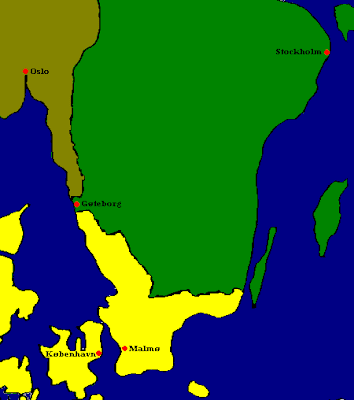
Expansion of the Swedish Empire

As we later found out, Norway isn't about the city life, it is about the nature that surrounds the cities. Whilst Oslo is beautiful in its own respect, the true beauty of Oslo comes into perspective when one ventures outside of the walls.


Oslo Port

Oslo was home to the 1952 Winter Olympics, which found their home among the many mountains and slopes of the glacier carved land. No wonder Norway has won more medals than any country for cross-country skiing!


Got Skis?

Oslo was the home of famed painter, Edvard Munch. His childhood was spent surrounded by the death of family members, which may attribute to the style of his paintings.
"Sickness, insanity and death were the angels that surrounded my cradle and they have followed me throughout my life." -Munch
The Edvard Munch Museum is home to over 1,100 Munch works (The Scream however is not on display as we found out, because it had been recently stolen and damaged)


Munch's Scream, recreated on a building

As we soon found out, the best of Norway was yet to come... stay tuned for a special feature, "Better Know a Scandinavian Mountain Range."

Friday, April 20, 2007

BKASC: Sarpsborg

Today's Better Know a Scandinavian City, and home of the original Bakkelund: Sarpsborg

Sarpsborg was founded by the Viking King Olav Haraldsson in 1016. Unfortunately most of the old city ended up in the river Glomma, after a mudslide between 1200-1400. The city was rebuilt at a safer location but was burnt down to the ground by the Swedish invaders in 1567 (are you getting the common theme here?)


Welcome to Sarpsborg

Sarpsborg is officially the brightest city in Norway, when it was declared the sunniest place in the entire country for the year 2005. I'm going to have to agree with them, as the one day we were there, the sun shone down on us.

The city was home to the family Bakkelund, before they immigrated around 1900 to America. The literal meaning of the name Bakkelund is, "hill-grove." A fairly accurate description of the Bakkelund that I know.


Jon, the first Bakkelund to return to the homeland.

The city is a blue collar economy, with many of its 50,000 inhabitants working industrial jobs. It is also home to Borg beer brewery, the most famous of the Norwegian Pilsners.


Bakkelund drinking a Borg in Sarpsborg, now there is a Norwegian scene

It is fairly clear why the Bakkelunds left Sarpsborg, as the city isn't much to look at. What is ironic however, is that the Norwegian countryside looks EXACTLY the same as the Wisconsin countryside. I guess people stick to what is familiar to them. Take a walk in Sarpsborg by clicking here.


Vestvannet Lake (Fjord?)

Thursday, April 19, 2007

BKASC: Gothenburg

Today's Better Know a Scandinavian City: Gothenburg


The city of Gothenburg was named after the Geats, famous from their portrayal in Beowulf. It is centrally located between the Norwegan stronghold in Oslo, and the Danish stronghold in Kobenhavn.


Goteborg

Because of its geographical location, the modern city is home to the most important port in Scandinavia. The city is also home to Gothenburg University and the Chalmers University of Technology, which together make Gothenburg the largest university city in Scandinavia.


A replica of the sailing ship Götheborg departed for China in a recreation of the historical 18th century trade route to the Chinese city of Guangzhou.

Economically, the city is home to the headquarters of Volvo (latin for "I roll"). Volvo, or "woll woll" in Swedish, is the worlds leading producer of heavy trucks, and is famous for their safety innovations such as the modern three-point seatbelt.


The Familiar Volvo Grill

The cuisine of the area is obviously rich in fish, and has become famous worldwide for the Feskekôrka ("Fish Church"), an indoor fish market. The city also has a number of star chefs – over the past decade, 7 of the Swedish Chef of the Year Awards have been won by Gothenburgers.


The Swedish Chef


The Swedish Eater


A walk along the port is common for Gothenburgers. The dialect of the Gothenburgers is, according to other Swedes, associated with cheerfulness and witty humor. No wonder I felt so at home there!


Gothenburg Harbor

Wednesday, April 18, 2007

BKASC: Malmö

Today's Better Know a Scandinavian City: Malmö

Malmö was originally settled as a Danish city in 1275, and was for many centuries Denmark's second largest city (after Kobenhavn). It remained a Danish city until the 17th century, when Sweden royally raped and pillaged what was left of Denmark, and took 1/2 of Denmark's territory. Because of this intense war history, Malmö served as a key military port throughout the Scandinavian wars.


King Karl X Gustav of Sweden, who took the city from Danish dominion

Wars aside, Malmö is now Sweden's third most populous city, and is located on the southernmost region of Sweden. Its close ties with Denmark have remained, and in 1999, a bridge was built connecting Copenhagen to Malmö. Many residents of Malmö choose to live in Malmö and commute 20 minutes by train to work in Copenhagen (given the opportunity, who wouldn't want to live in Sweden?)


The bridge-tunnel Oresund, the longest combined road and rail bridge in Europe.

Upon first arrival, it is not easy to distinguish Sweden from Denmark, but the subtle differences are what make Sweden the best country on Earth (citation needed).
Jon, seconds after entering Sweden: "I wonder how long it will be until we see our first IKEA?"
Ben: "There's one!" (pointing to an IKEA)
After soaking up a lifetime of Swedish identity, I walked into a local church, and high school choir of Swedish girls were singing a hymn of Heaven on earth (I can only assume). Not a bad way to spend my first moments in the homeland.


Blonde haired women grow on trees and Swedish meatballs rain from the sky in this land of milk and sweet lingonberry honey.

Malmö is home to Scandinavia's tallest building, the Turning Torso. Don't be too surprised if I come home with a 6,000 kroner mortgage for a flat in this beauty.


The design gives the building the appearance of a vine twisting its way up a pole toward the sun.

Great Scandinavian city, or greatest Scandinavian city? ...it's too early for me to judge.


One need not sightsee or worry about visiting all the important landmarks while in Malmö, just sit back and take in the beauty.

Tuesday, April 17, 2007

BKASC: Kobenhavn (Copenhagen)

Today's Better Know a Scandinavian City: Kobenhavn

Kobenhaven is Denmark's largest city, with 1.8 million Danes living in the greater Kobenhavn area. The name Kovenhavn, literally translates to merchants harbor, and it couldn't be more true.


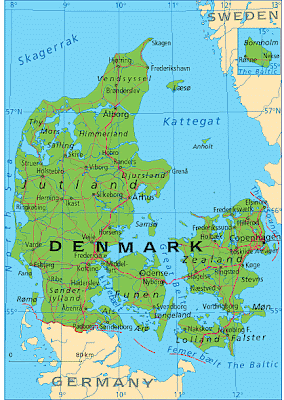
Denmark

The city is situated on the Island of Sjælland, which is connected to the rest of Denmark by the Great Belt Fixed Link, which is the worlds second longest suspension bridge. The two towers that make up the bridge are actually the highest points in all of Denmark.

Despite being an expensive city to live in, it has been rated the number 10 city in the world to live in. It is home to Strøget, the longest pedestrian shopping street in the world, which does not disappoint (if you like shopping.) I also made my European debut at a karaoke bar on this street, which will quickly become known as "The street Ben made his big break."


Strøget at Night

Perhaps the biggest draw of the city, however, is the port and its surrounding waters. The city was founded by Vikings around 1167, so a location along the water and trade routes was vital.


Viking Ship Museum

The area of the city known as Nyhavn is home to the famous colored buildings along the harbor, which today offer a variety of places to eat. The north side of the port used to be called the naughty side, with sailors visiting small flats during their shore leave. The south, or nice side of the port was home to the markets which sailors sold their goods at.


Nyhavn

A controversial portion of the city, known as Christiania, cannot be described, but is rather experienced. The neighborhood covers 85 acres in Copenhagen and is home to 850 pseudo-residents in the "lawless" city (recently regulations on hard drugs have been enforced by Copenhagen Politi). This "Freetown" has established semi-legal status as an independent community, and has been passed as a social experiment by the Danish Government.


A walk down pusher street

Who could forget that Hans Christian Anderson comes from Denmark? Many of his stories were inspired by the sights and sounds in Denmark.
"Far out at sea the water´s as blue as the petals of the loveliest cornflower, and as clear as the purest glass; but it´s very deep, deeper than any anchor can reach. Many church steeples would have to be piled up one above the other to reach from the bottom of the sea to the surface. Right down there live the sea people."

Den Lille Havfrue (The Little Mermaid)

Also born and buried in Copenhagen was famous Philosopher, the Father of Existentialism, Søren Kierkegaard.
"Life can only be understood backwards; but it must be lived forwards."

Kierkegaard's Grave

It is easy to see why the arts have flourished in this city, and it has quickly become the cultural center of Scandinavia. A stroll down Nyhavn Vej clearly gave and continues to give inspiration to all that walk in its path.